
Introduction
In the world of data analysis, missing data is a common challenge. Whether due to non-responses in surveys, data entry errors, or other reasons, missing data can significantly impact the results of statistical analyses. Statistical imputation is a technique used to fill in these missing values with substituted ones, allowing for more complete and accurate analyses.
Types of Missing Data
Before diving into imputation methods, it’s essential to understand the types of missing data:
- Missing Completely at Random (MCAR): The absence of data is entirely random and unrelated to any observed or unobserved data.
- Missing at Random (MAR): The absence of data is related to observed data but not the missing data itself.
- Missing Not at Random (MNAR): The absence of data is related to the missing data itself.
Imputation Techniques
- Mean/Median/Mode Imputation: One of the simplest methods is to replace missing values with the mean, median, or mode of the observed data.
- Mean Imputation: Suitable for continuous data.
- Median Imputation: Useful when the data has outliers.
- Mode Imputation: Best for categorical data.
- Regression Imputation: This method uses regression models to predict and fill in missing values based on other available data.
- Multiple Imputation: Multiple imputation involves creating several different imputed datasets and combining the results. This method accounts for the uncertainty around the missing data.
- K-Nearest Neighbors (KNN) Imputation: KNN imputation replaces missing values with the mean or median of the nearest neighbors’ values.
Applications of Imputation
Imputation is widely used in various fields, including:
- Healthcare: Handling missing patient data in medical research.
- Market Research: Dealing with incomplete survey responses.
- Finance: Filling in gaps in financial time series data.
Imputation in NeoStat
NeoStat can perform automatic imputation with the Impute node. You simply feed it the data set and select the preferred type.
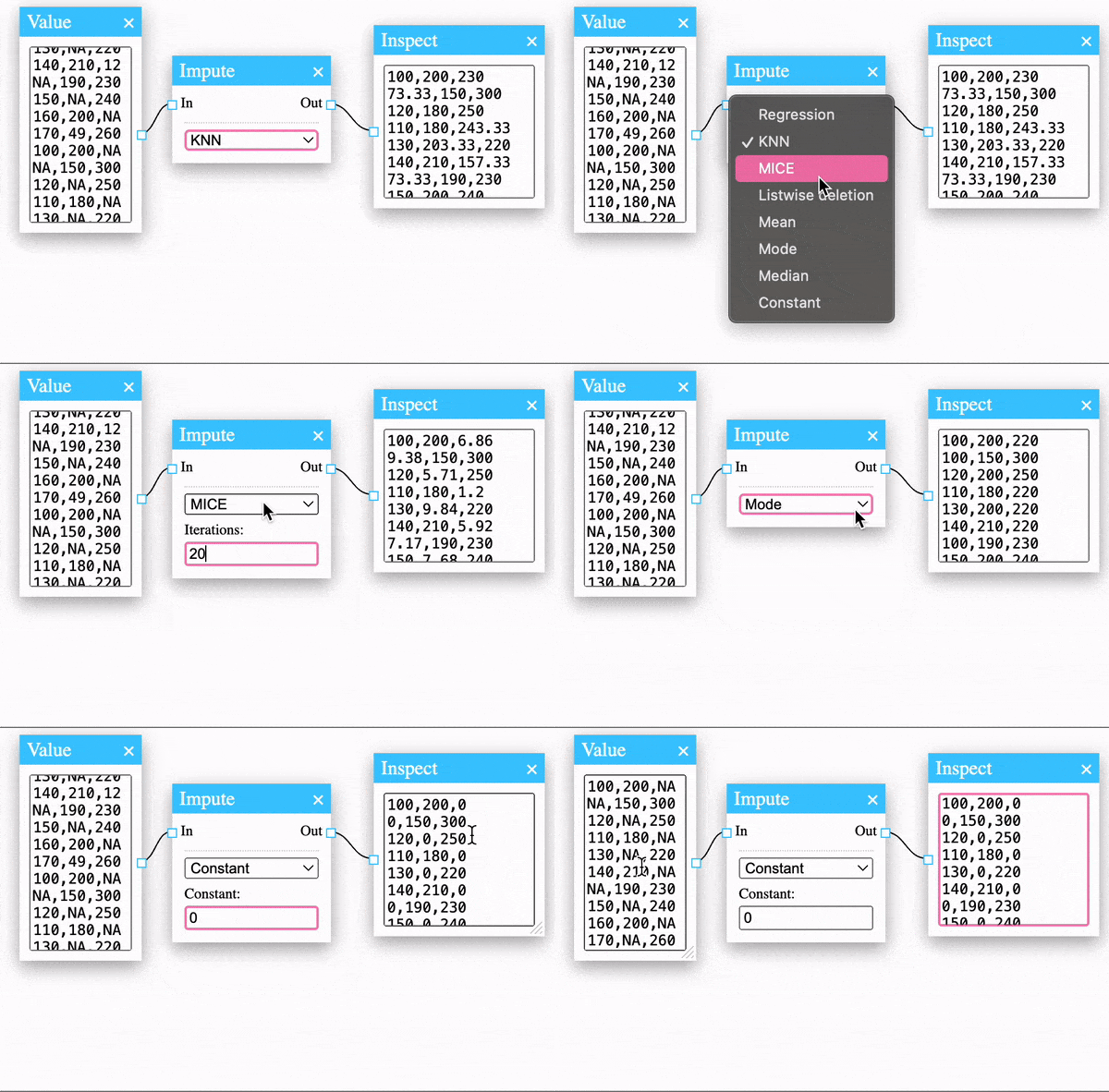
It has support for all imputation methods mentioned in this post, even Multiple imputation by chained equations.
 Simple Statistics
Leave a comment